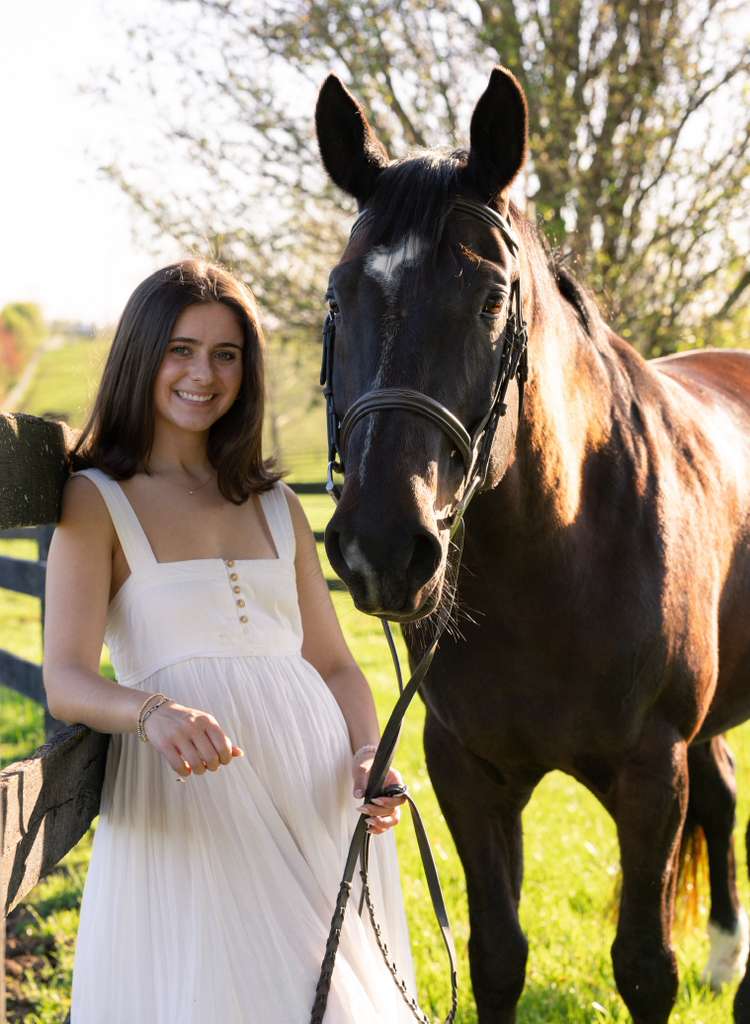
The drive from Paris to Deauville takes roughly two hours, and somewhere in the Calvados département, the landscape starts to rearrange itself. The pastures get larger. The hedgerows give way to board fencing. There are mares in fields, yearlings clustered near water troughs, the particular still quality of a landscape that has organised itself around horses. The first time I made that drive, something settled in me that I didn't expect. I'd felt it before. I knew exactly where I'd felt it.
I'd felt it on the road from Lexington out toward the Kentucky Horse Park.
The Easy Parallels
The surface similarities between Lexington, Kentucky and Deauville, Normandy are easy enough to list. Both are defined architecturally and economically by Thoroughbred breeding. Both have a particular relationship between old money, land, and horses that shapes everything from real estate values to the local restaurant menu. Both have an August that transforms the place — the sales, the racing, the influx of people who understand what a conformation shot is and why it matters.
Both towns have the same quality of light over a good paddock in the early morning — something golden and unhurried that feels borrowed from a different era. Both have the smell of cut grass and manure that people who didn't grow up around horses find odd and people who did find instantly comforting.
But the parallels run deeper than aesthetics. What both places share, at their core, is that horses are not a hobby there. They are infrastructure. They are the reason the roads were built where they were, why certain families have been in certain valleys for generations, why the summer calendar looks the way it does. You cannot understand Deauville without understanding the haras system — the great breeding farms of the bocage, some of which have been producing champions for over a century — just as you cannot understand Lexington without the operations that have shaped the Bluegrass for two hundred years.
What's Different, and Why It Matters
What's different is harder to articulate and, I think, more interesting.
French equestrian culture tends toward restraint. The horses are magnificent, and everyone knows it, but there is a certain reluctance to perform that magnificence loudly. A good haras in Normandy doesn't need to market itself. Its reputation precedes it across decades, sometimes across centuries. The confidence is so deep it becomes quietness.
American equestrian culture is louder and more democratic. The access points are wider — in Kentucky you find the great Thoroughbred farms, but you also find the 4-H circuit, the trail riding clubs, the barrel racing competitions at the county fair. The horse world in America is plural in a way that the Norman horse world isn't, and I've come to think that's both a strength and a limitation.
In Normandy, equestrian culture is more stratified, more codified, and more connected to a specific aristocratic and agricultural tradition that has not been interrupted in the way that American culture has been remade. The haras at Haras du Pin — the national stud founded under Louis XIV — is still functioning. The knowledge passed down within it is genuinely old knowledge. There is no American equivalent of that kind of continuity.
"In Normandy, a good horse operation doesn't need to market itself. In Kentucky, even the best ones do. That difference tells you something about the relationship between confidence and culture."
What They Share at the Deepest Level
What I find meaningful is this: in both places, the person who knows horses is recognisable to other people who know horses. There is a shared language that operates below nationality and language and class — not just vocabulary, though there is that too, but a way of standing near a paddock fence, of reading an animal from a distance, of slowing down automatically when a horse is doing something worth watching. It's a kind of literacy that takes years to acquire and never quite leaves you.
I felt at home in Normandy partly because of that language. I had learned a version of it in Virginia, refined it in competition rings across the East Coast, and brought it with me when I arrived in France. The grammar was the same. The accent was different. But the conversation was immediately possible.
What Two Homes Teach You
Having spent serious time in both horse countries, I've stopped thinking of myself as an American in France, or a French-influenced American. I've started thinking of myself as someone from horse country — wherever horse country happens to be. The identity is more portable than the geography.
There is a particular kind of belonging that comes from knowing what the five o'clock morning light looks like over a field of horses. From knowing how to read the angle of an ear, the set of a neck, the quality of stillness in a paddock that tells you something is either very right or very wrong. That knowing doesn't require a passport. It doesn't care which side of the Atlantic you're standing on.
Horse country is horse country. I've been lucky enough to find it twice.